
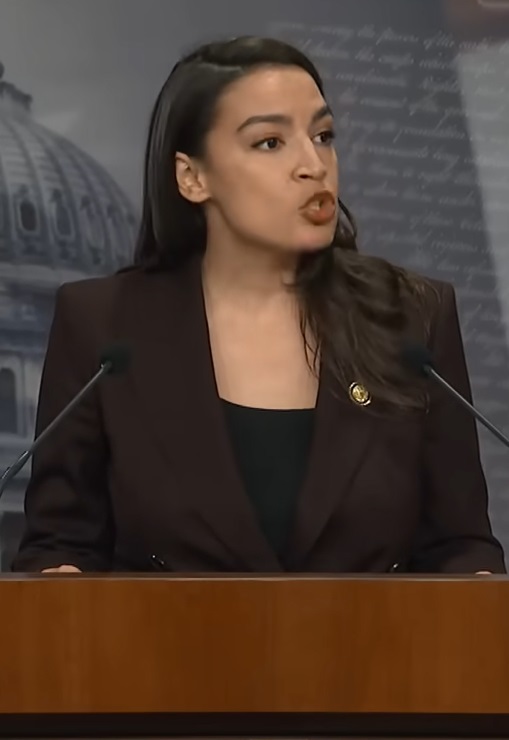
Congresswoman Alexandria Ocasio-Cortez teamed up with Bernie Sanders last week to introduce a bill that would put a moratorium on building new AI data centers (read here, and notice it leads with examples of numerous AI and business titans talking about its effect on industry) until certain conditions are met – namely, creating federal safeguards for AI to curb it from “affecting everything from our economy and well-being, to our democracy, warfare and our kids’ education.”
Here’s vid from AOC’s portion of the press conference.
Some key voices in the Democratic party immediately voiced opposition, which indicates the bill is probably doomed but not the political messaging.
More on that later.
First, to AOC’s presser:
Notice a few things.
- She talks about layoffs associated with AI – both ones that have already been attributed to it and those that have been warned about.
- Then she immediately shifts to Sam Altman’s testimony before Congress where he “begged us to regulate this industry” to prevent mass layoffs and benefit working people.”
- She followed with another Altman quote from 10 years ago: “AI will probably lead to the end of the world, but in the meantime there will be great companies created.” (some context to that quote here).
- AOC: “It’s our responsibility to take care of the people”; not Altman’s company (OpenAI) or said-companies.”
Now here’s the money quote that shows where the messaging is going on this:
AOC:
“Unfortunately, the leaders of this industry have repeated time and time again that they view working people as an endless untapped market to be manipulated and exploited.
That they would sell our country out if it meant that they could turn a profit.”
Translation: Wealth inequality.
Another potent message beyond wealth inequality — Privacy.
AOC:
“It is no surprise that in the four years since ChatGPT was released, we have seen AI deployed at a massive scale to create Big Brother-type surveillance.”
She continues:
“Companies like Palantir are mining endlessly the data and privacy of the American people, keeping track of everything that they say and do and sending it all to a militarized and centralized government.”
And why Americans should take the privacy threat seriously:
“When you take the subway, when you share a Tik-Tok, when you talk to your Alexa at home, they are collecting your data and figuring out new ways to weaponize it. And now they are using AI tools to automatize this so that it is not only pervasive but that it is effortless. We must sound the alarm now.”
Now to another political message — Affordability.
“These companies are now so desperate to profit off of the AI boom that they are racing to construct thousands of giant AI data centers and jacking up the utility costs of everyday Americans to pay for it. These data centers power thousands of high intensity computer chips that are processing at all times and require massive amounts of energy.”
And so… “People’s energy bills around the country are skyrocketing in order to pay for these AI data centers for them.”
Plainly: She integrates wealth inequality, privacy, and affordability into one issue (AI data centers), and that’s pretty good politics.
Here’s what gives it extra kick — some of AI’s biggest backers are practically household names.
The two most visible names are Sam Altman and Elon Musk, both of whom are very rich, very visible, and very controversial.
Another obvious name is Peter Thiel, though he isn’t quite a household name, although it’s getting there. And of course Alex Karp, who has all the makings of getting there, as well.
In normal class politics, progressive politicians usually say the “billionaires running the system.” But “Larry Fink” is gonna draw a lot of blank stares.
In other words, AOC already has data center foils that are controversy magnets (and magnates).
That matters, politically.
Her closing message: If AI wins, Altman, Musk and the Bro-Logarchs get richer, and you have to foot the bill of these huge data centers.
That last point is increasingly being addressed, but AI leaders let Americans paying high utility bills go on long enough that I think it’s contributed to a crystalizing of negative public thought towards it.
However…
Politically: Like I said, this billl is unlikely to pass.
At Axios’ AI+ DC Summit, key Democratic Sen. Mark Warner immediately called the idea of a moratorium “idiocy…. a data center moratorium simply means China is going to move quicker” and “the idea that we’re going to stuff this back into the bottle, this genie, that’s a ridiculous premise.”
John Fetterman also squashed the idea on X: “I refuse to help hand the lead in AI to China. The AI chassis can either come from China or the USA. That’s an easy choice.”
But ironically, that might actually help AOC’s fight.
In politics, fighting a losing battle can be a win, if a) the public is on your side of the message and b) it fits into a broader argument that’s also politically popular at this moment – that the middle and lower classes are getting increasingly squeezed by cost of living while the richer are getting richer.
And AOC has reason to think taking on AI in some fashion could be a popular cause.
In fact, an NBC poll this month showed registered voters think the the risks of AI outweigh the benefits, 57%-34%.
And here’s something fascinating about the poll – the youngest are most negative!
The demographic groups with the most negative views of AI are voters ages 18-34, among whom the net favorability rating for AI is minus 44, and women ages 18-49, who reported a net AI favorability rating of minus 41.
In other words, the group most opposed to new technology is the younger generation.
My guess – because young college graduates are struggling to find new jobs and younger adults are constantly hearing warnings (including from AI leaders) about vast swaths of jobs that could be wiped out in the future.
Having a foil that you essentially can’t stop (the inexorable advance of AI) can actually work in your favor because you don’t have to come up with something that addresses the need to adapt to the globe’s changing reality (Warner’s concerns).
Thus, I don’t think AOC and Bernie can win, legislatively, on this, but politically? Yeah. I think so.
It’s one of those issues that highlights the macro frustration of wealth inequality + the growing mass movement against what technology is really doing to us (the success of Jonathan Haidt’s Anxious Generation has become so vast that you can see a political movement arising from it).
AOC has a winning issue here, politically, even if it’s bound to fail.
And I don’t think she’s doing it cynically.
This fits perfectly with the consistent message she and Bernie have been highlighting on their Fighting the Oligarchy Tour. And it’s been a winning one across the country, as the affordability issue that doomed Democrats in 2024 threatens to doom Republicans in 2026.
On X, yesterday, she tweeted this warning:
Politicians – especially Dems – should pledge not to take AI money.
— Alexandria Ocasio-Cortez (@AOC) March 26, 2026
They are buying up influence ahead of the midterms, and Dems who take AI $ will lose authority and trust as the public bears the cost.
Their money will end up being toxic anyway. People are catching on.
Now, I do think the Trump Administration gets the political threat that AI poses to GOP.
The White House said last week that Congress should “preempt state AI laws” that it views as too burdensome, laying out a broad framework for how it wants Congress to address concerns about AI without curbing growth or innovation in the sector.
The legislative blueprint outlines a half-dozen guiding principles for lawmakers, focusing on protecting children, preventing electricity costs from surging, respecting intellectual property rights, preventing censorship and educating Americans on using the technology.
Companies that committed to Trump’s pledge to protect ratepayers include Google, Microsoft, Meta, Oracle, xAI, OpenAI and Amazon. The companies agreed to build or buy new sources of power generation for their data centers and cover the expense of infrastructure upgrades.
In other words, the Administration is “Full Steam Ahead!” while also recognizing the severe political vulnerability of its push on AI.
Browse the All-In Podcast, and you’ll see vid after vid of some of the most influential pro-AI voices acknowledging the industry faces a deep crisis in messaging.
So I doubt AOC wins on vote count here, but politics, yeah.
AI’s massive energy demands are scrambling party lines, and efforts to halt construction could be an attractive political message on both sides of the aisle ahead of the midterms.
Now…. here’s another political thing to keep an eye on:
Some things in life are powered by Duracell.
JD Vance’s political ascent has been significantly powered by AI titans like Peter Thiel (See this classic piece from The New York Times: “How a network of tech billionaires helped JD Vance Leap into Power.”
AOC and JD seem to reserve special animosity towards one another (examples: here and here, but there are tons out there) that goes beyond the “Hey, I might run against you in 2028” jockeying.
One final thought: I’ve got a hunch that Palantir is on its way to becoming the bete noire of AI with Alex Karp and Peter Thiel the horsemen.
By the time it’s 2028, there’s a reasonable chance that Dems are throwing around nicknames of billionaires like “Peter Palantir Thiel” and somehow linking them to JD Vance in a way that makes things stick.
After all, the famous irony is that JD made his political career from the backstory of the hollowing out of manufacturing, yet might himself be an integral player in a future that could hollow out multiple industries.
Whether it’s AOC or someone else making that connection remains to be seen, but expect to hear a lot more from AOC on AI (unless, of course, everyone loves it by then).
